It multiplies local capacity.
Village helps local partners keep using training material, lessons, procedures, translated explanations, and community records after a visiting team leaves. Knowledge stays with the partner, not the team.
Village brings local AI, curated knowledge, and resilient mesh networking to ministry sites where the internet is weak, expensive, or absent.
Village Mission Kit is a portable, offline AI and knowledge system that helps ministry teams and local partners teach, translate, coordinate, train, and preserve useful local knowledge in places where internet access is unreliable or unavailable.
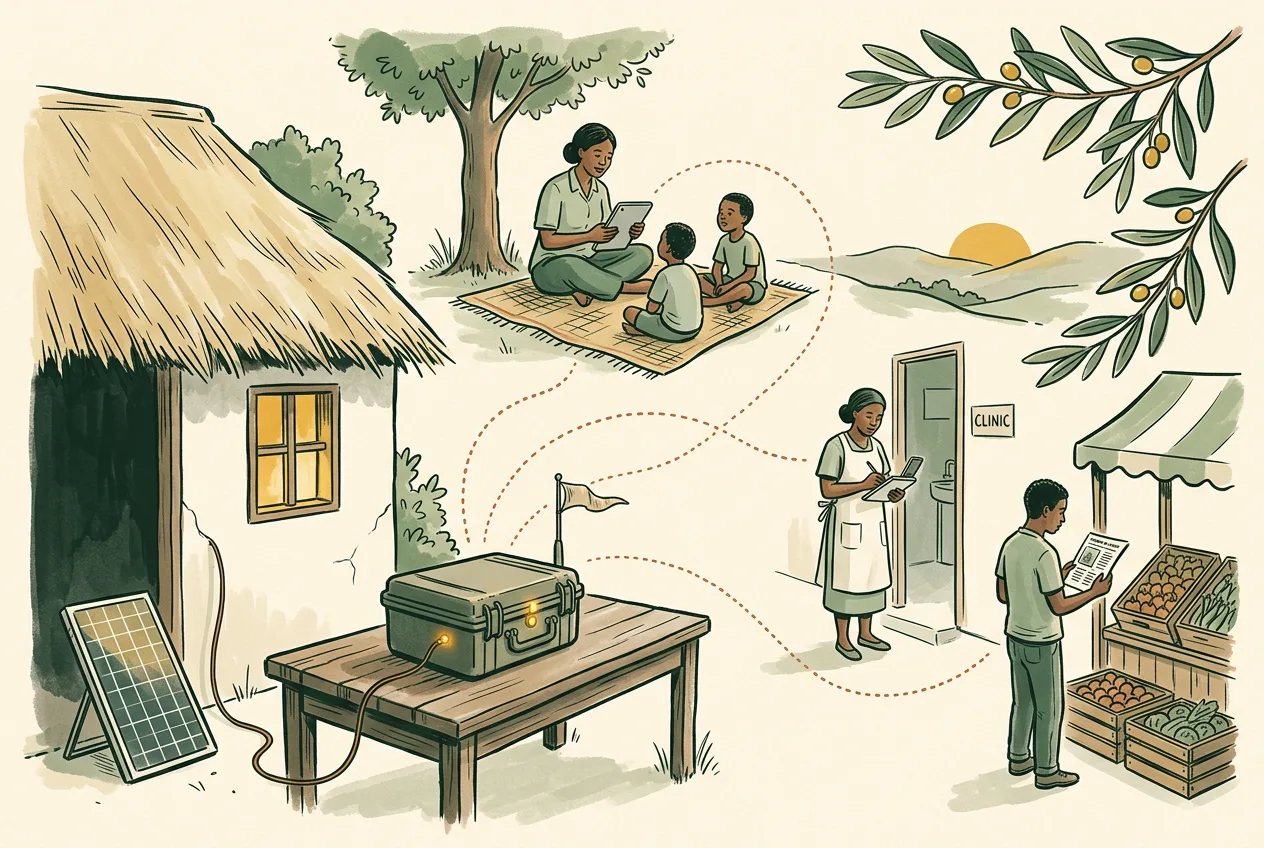
Village addresses this by bringing a local knowledge and coordination hub into the field. A mission organization can deploy one rugged compute box, local AI models, curated knowledge packs, solar power, and Haven mesh nodes.
Phones and laptops nearby can connect without internet. When the link is weak, Reticulum provides identity, encrypted messaging, discovery, and store-and-forward workflows.
The goal is not to replace ministry workers, local leaders, teachers, clinicians, or pastors. The goal is to give them a resilient tool that extends their ability to serve, teach, remember, coordinate, and hand off responsibly.
The goal is not to replace ministry workers, local leaders, teachers, clinicians, or pastors. The goal is to give them a resilient tool that extends their ability to serve, teach, remember, coordinate, and hand off responsibly.
Village is built around what visiting teams keep wishing they could leave behind: a working tool, not just a memory.
Village helps local partners keep using training material, lessons, procedures, translated explanations, and community records after a visiting team leaves. Knowledge stays with the partner, not the team.
Short-term teams generate value — local needs, lesson material, translation notes, follow-up tasks — that often gets lost. Village preserves those artifacts locally and produces handoff notes, summaries, and follow-up lists.
Offline-first, local models, local data, solar-deployable hardware, local mesh access, no cloud dependency for core operation. Built for the opposite environment most AI assumes.
Tutoring, teacher support, health education, entrepreneurship, agriculture, translation, community bulletins, and optional, locally approved faith content — used as a tool of service, not a substitute for embodied ministry.
Five concrete patterns we've designed for. Each shares the same kit; the content, safety policies, and operator handoff are tailored to the site.
A school, church, or community center can support tutoring, reading practice, math help, language learning, lesson planning, quizzes, and teacher prep — without internet.
Explains approved health education material, translates clinic instructions, summarizes non-diagnostic notes, and organizes follow-up lists.
Helps local partners teach business planning, budgeting, customer service, repair skills, agriculture practices, solar safety, and trade skills with curated local content.
During a deployment, collects reports, requests, supply needs, prayer needs (where appropriate), maintenance issues, and daily notes from the team.
When normal communications are down, provides local access to maps, procedures, supply lists, shelter information, generator manuals, training material, and field reports.
The important product is not the model.The important product is a repeatable, locally stewarded mission kit.
Village fits ministries already investing in education, medical missions, community development, disaster response, rural missions, church planting, or local leadership development. It gives existing work a practical platform rather than inventing a separate program.
The system runs locally and preserves local ownership. Sensitive community data does not need to ship to a cloud service. It can be handed off, audited, exported, backed up, or wiped according to the agreement with the local partner.
Start with one pilot kit and grow into repeatable deployment profiles — education, clinic support, community development, maintenance, disaster response, locally approved discipleship — each carrying the same foundation with different content and safety policies.
If open sourced well, ministries, churches, NGOs, educators, clinicians, and local partners can contribute knowledge packs, deployment guides, language packs, workflow apps, field-tested hardware profiles, safety policies, and training material. Early backers help shape the ecosystem.
Operators trained · tutoring sessions supported · lessons generated · reports captured · time to deploy · time to complete handoff · deployments active after the visiting team leaves · qualitative feedback from local partners. Practical metrics, not vanity.
A staged rollout designed to learn responsibly before scaling. Each phase has a clear goal, deliverables, and a decision gate.
Turn the current demo stack into a repeatable field pilot.
Deploy one kit with a trusted ministry partner and one local site.
Package what worked into a reusable deployment model.
Local AI models, small efficient compute, solar power, and resilient mesh networking have reached a point where this is practical. What's missing is a product that is prepared responsibly, deployed simply, used locally, and handed off with care.
Village can become that product. With the right backing, it can help ministries serve communities where normal digital infrastructure does not reach — while strengthening local leaders rather than making them dependent on distant systems.
Backing Village is not primarily backing an AI tool. It is backing a new kind of field infrastructure for service, learning, continuity, and responsible handoff.